Jumat, 23 Desember 2011


Kamis, 22 Desember 2011
ACHMAD SADALI KNOW (1924 - 1987) by Agus Sachari
 |
| ACHMAD SADALI 1924 - 1987 |
THUSDAY, DECEMBER 22, 2011 - DENMAS PRIYADI BLOG : A painter who was a pioneer of art and design education at ITB isAchmad Sadali. Education has ever gone through the Faculty of Engineering University of Indonesia Department of Fine Arts(now ITB) 1949-1953, University of Iowa, USA, Art TeacherCollege, Columbia University, USA, Art Student League NYC-USA. Appointed Chairman of the Department of Fine Arts ITB in1962 to 1968. In the year 1968 -1969 served as Dean of the Faculty of Planning and Visual Arts ITB. Year 1969-1976 asassistant rector of Community Affairs ITB. Earlier in 1972 was awarded the Arts Award from the Ministry of Education andCulture. He is also a lot of solo exhibitions in Jakarta, Surabaya,Bandung, Yogyakarta, and joint exhibitions at home and abroad.Achmad Sadali earned a professor of fine arts from the Bandung Institute of Technology. character painting in the early period of his career known as a sensible Abstract Geometric. In a further development once the breath seems to Islamannya that dominatehis works.
MENGENAL ACHMAD SADALI (1924 – 1987)
 |
| Image ACHMAD SADALI by Slamet Priyadi |
KAMIS, 22 DESEMBER 2011 - DENMAS PRIYADI BLOG : Seorang pelukis yang sekaligus juga perintis pendidikan seni rupa dan desain di ITB adalah Achmad Sadali. Pendidikan yang pernah ditempuhnya adalah Fakultas Teknik Departemen Seni Rupa Universitas Indonesia ( kini ITB ) 1949-1953, University of Lowa USA, Art Teacher College, Columbia University USA, Art Student League NYC-USA. Menjabat Ketua Departemen Seni Rupa ITB pada tahun 1962- 1968. Pada tahun 1968 -1969 menjabat sebagai Dekan Fakultas Perencanaan dan Seni rupa ITB. Tahun 1969-1976 sebagai pembantu Rektor ITB Bidang Kemasyarakatan. Sebelumnya Pada tahun 1972 memperoleh penghargaan Anugerah Seni dari Departemen Pendidikan dan Kebudayaan. Ia juga banyak pameran tunggal di Jakarta, Surabaya, Bandung, Yogya, dan pameran bersama di dalam dan di luar negeri. Achmad Sadali memperoleh gelar guru besar bidang seni rupa dari Institut Teknologi Bandung . karakter lukisan pada periode awal karirnya dikenal sebagai yang berpaham Abstrak Geometris. Dalam perkembangan selanjutnya Nampak sekali nafas ke-Islamannya yang mendominasi karya-karyanya.
Karya-karya lukisannya beberapa di antaranya adalah :

 |
| Flower Arrangemet |
Posted by Slamet Priyadi in Lido - Bogor
Senin, 19 Desember 2011
ANGKLUNG MUSIC by Slamet Priyadi
 |
| DAENG SUTIGNA 1908 - 1984 |
MONDAY, 19 DECEMBER 2011 - DENMAS PRIYADI BLOG: If we hear the word angklung course we will immediately thought of one type of musical instrument. Hence the word angklung is already very well known by the Indonesian people, especially people of West Java. Yes, angklung is one type of musical instrument native to the area west of Java in recent years the existence of the angklung music has been increasingly recognized not only nationally and even internationally.
Angklung music instrument made of bamboo are the type of tree that is very much thriving in Indonesia, especially in the
Angklung music instrument made of bamboo are the type of tree that is very much thriving in Indonesia, especially in the
 |
| ANGKLUNG MELODI |
This type of musical instrument angklung consists of:
1. Angklung melodies that are subdivided into:
a. Angklung consisting of small melodic tone g to c'''(c stripe 3), and
b. Angklung great melody with tone G to fis.
2. Accompaniment angklung 12 units consisting of:
a. 8 pieces septin dominant chord (Best7, F7, C7, D7, A7, E7, and B7). Each angklung consists four tubes.
b. 4 pieces minor chord (Dm, Em, Am, and Bm).
3. Angklung Bas (contra bass).
4. Angklung contra accompagnement, the same shape as the angklung accompaniment,
But the tone oktafnya higher.
In order angklung music we enjoy and we feel its beauty then it should be played by several players. The number of players is very dependent on the type of unit used angklung. There are three different types of units which angklung, a small unit, medium, and large.
1. One small unit angklung consists of:
a. Two sets of angklung small melodies, from tone to tone a g''(a stripe
two) with 27 tones.
b. A set of angklung great melodies, from tone to tone C fis.
c. A set of angklung accompaniment there are 8 pieces consist of:
- Major: C7, D7, F7, G7, and Bes7.
- Minor: Am, Dm, and Em.
2. One unit of angklung is made up of:
a. Two sets of small melodic angklung consists of 1 to 27 pieces
b. A set of angklung great melody consists of tones G up a tone of fis.
c. A set of 13 pieces of angklung accompaniment consists of:
- Major: C7, D7, E7, F7, G7, A7, Bes7, and B7.
- Minor: Am, Dm, Em, Gm, and Bm.
3. One unit of angklung consists of:
a. Two sets of angklung little melody as much as 1 to 27 pieces.
b. A set of angklung tone melody of tone G to fis.
c. A set of angklung accompaniment consists of 24 pieces:
- Major: C7, Cis7, D7, and Dis7 as many as 12 pieces.
- Minor: Cm, CISM, and Dm as many as 12 pieces.
How to play angklung musical instrument?
How to play it is by shaking the angklung, left hand holding the center of the angklung bamboo slats and bottom right hand shaking the angklung. Clearly the left hand holding the angklung in which a small tube leading to the next kiridan large tube leading to the right. The right hand holds the bottom of the angklung, in
part this is a shake or vibrated in accordance with note values that exist in the song being played
MUSIK ANGKLUNG by Slamet Priyadi
SENIN, 19 DESEMBER 2011 – DENMAS PRIYADI BLOG : Jika kita mendengar kata angklung tentu kita akan langsung teringat pada salah satu jenis alat musik. Oleh karena kata angklung ini sudah sangat dikenal oleh masyarakat Indonesia, terutama masyarakat Jawa Barat. Ya, angklung memang salah satu jenis alat musik asli daerah Jawa barat yang akhir-akhir ini keberadaan musik angklung sudah semakin dikenal bukan saja secara nasional bahkan internasional.
Instrumen musik angklung terbuat dari bahan bambu yaitu jenis pohon yang memang sangat banyak tumbuh subur di Indonesia terutama di daerah Jawa barat. Dari bahan bambu inilah kemudian dibuat alat musik angklung yang disusun sedemikian rupa dengan nada-nada tertentu sehingga menjadi alat musik angklung yang jika dimainkan dengan baik akan mengeluarkan alunan nada-nada yang indah. Pada awalnya musik angklung menggunakan tangga nada pentatonis yaitu tangga nada yang biasa dipakai pada musik daerah umumnya. Akan tetapi sesuai dengan keberadaan musik angklung yang semakin berkembang, alat musik angklung menggunakan nada-nada diatonis barat. Sosok tokoh yang mempelopori perubahan tangga nada dari pentatonis ke tangga nada diatonis adalah seorang tokoh musik tradisional yang berasal dari Garut, Daeng Sutigna pada tahun 1928. Konser pertama kali musik angklung dengan menggunakan tangga nada diatonis dimainkan oleh anggota kelompok pramuka di Linggarjati tahun 1947.
Jenis intrumen musik angklung terdiri atas :
1. Angklung melodi yang dibagi lagi ke dalam :
a. Angklung melodi kecil yang terdiri dari nada g sampai c’’’ ( c setrip 3 ), dan
b. Angklung melodi besar dengan nada G sampai fis.
2. Angklung pengiring sebanyak 12 buah yang terdiri atas :
a. 8 buah paduan nada dominan septin ( Best7, F7, C7, D7, A7, E7, dan B7 ). Setiap angklung terdiri 4 tabung.
b. 4 buah paduan nada minor ( Dm, Em, Am, dan Bm ).
3. Angklung Bas ( contra bas ).
4. Angklung contra accompagnement, bentuknya sama seperti angklung pengiring,
Akan tetapi nada oktafnya lebih tinggi.
Agar musik angklung dapat kita nikmati dan kita rasakan keindahannya maka harus dimainkan oleh sejumlah pemain. Adapun jumlah pemain sangat bergantung pada jenis unit angklung yang digunakan. Ada tiga macam jenis unit angklung yaitu, unit kecil, sedang, dan besar.
1. Satu unit kecil angklung terdiri dari :
a. Dua set angklung melodi kecil, dari nada g sampai dengan nada a’’ ( a setrip
dua ) dengan 27 nada.
b. Satu set angklung melodi besar, dari nada C sampai dengan nada fis.
c. Satu set angklung pengiring ada 8 buah terdiri dari :
- Mayor : C7, D7, F7, G7, dan Bes7.
- Minor : Am, Dm, dan Em.
2. Satu unit angklung sedang terdiri dari :
a. Dua set angklung melodi kecil terdiri dari 1 sampai dengan 27 buah
b. Satu set angklung melodi besar terdiri dari nada G sampai dengan nada fis.
c. Satu set angklung pengiring sebanyak 13 buah terdiri dari :
- Mayor : C7, D7, E7, F7, G7, A7, Bes7, dan B7.
- Minor : Am, Dm, Em, Gm, dan Bm.
3. Satu unit angklung besar terdiri dari :
a. Dua set angklung melodi kecil sebanyak 1 sampai dengan 27 buah.
b. Satu set angklung melodi besar dari nada G sampai dengan nada fis.
c. Satu set angklung pengiring sebanyak 24 buah terdiri :
- Mayor : C7, Cis7, D7, dan Dis7 sebanyak 12 buah.
- Minor : Cm, Cism, dan Dm sebanyak 12 buah.
Bagaimana cara memainkan instrumen musik angklung?
Cara memainkannya adalah dengan menggoyangkan angklung, tangan kiri memegang bagian tengah bilah bambu angklung dan tangan kanan menggoyangkan bagian bawah angklung. Jelasnya tangan sebelah kiri memegang angklung di mana tabung kecil mengarah ke sebelah kiridan tabung besar mengarah ke sebelah kanan. Tangan kanan memegang bagian bawah angklung, pada bagian inilah yang digoyang-goyangkan atau digetarkan sesuai dengan nilai not yang ada dalam lagu yang dimainkan.( Referensi: Seni Musik SMA, Matius Ali )
Rabu, 14 Desember 2011
"SKIN PUPPET BETAWI" by Slamet Priyadi
 WENDNESDAY DECEMBER 14, 2011 - Denmas Priyadi BLOG: Around the seventies when I was a teenager, I never watch puppet performances at Crocodile Hole area, East Jakarta. At that time I do not know if I watched the puppet arts are Wayang Betawi, because to my knowledge at that time the puppet is a form of public art Java, especially Central Java, where I come from. I know it is only then that I witnessed the puppet Puppet Betawi wayang after I enjoyed it until the finished leather. It turns out that I watched the puppet speak Indonesian with here and there adorned with distinctive dialect of Jakarta, full of humor and a bit humorous dialogue between the puppeteer and the nayaga. Skin Betawi puppet that I saw it played by a puppeteer who at that time his name was well known by local people named, Bonang.
From the experience mentioned above has intrigued me to learn more about the art Wayang Betawi.
Skin Betawi puppet is a puppet show that uses puppets made of buffalo skin and application of game show is still in Java. Accompanied by a set of gamelan music with martial drums became the dominant music in the accompanying motion puppet songs with a lilting Sundanese sung by the singer.
In Betawi Wayang performances with Javanese puppet shows, puppeteer using a puppet and a box of eight players who played gamelan music as accompaniment puppet show.
In the region of Lubang Buaya (Crocodile Hole), Cijantung, Pasar Rebo, and surrounding areas, r puppeteer Bonang was the only game mastermind who puppeteers other than his contemporaries, it is said he even exceeded his own teacher, Mr. Misan the first resign as a puppeteer Puppet Skin Betawi.
Puppet Skin Betawi including one form of traditional art Jakarta area that is still favored the local community. This is evident in every performance in the areas surrounding Jakarta audience participation is always there, visible from the dialogue between the puppeteer and the audience, puppeteer and one of the gamelan players. They said, replied with a dialogue "nguda taste" (talking to yourself).
Leather Puppet Betawi musical accompaniment is a set of gamelan consist Kromong 10 tones, demung 7 tones, 2 saron with 5 tones, two tap, one kempul and a gong. As the carrier is an instrument fiddle melody or it could be the singer. As for the music barreled Slendro.
Wayang stories Betawi sources vary, can of folklore such as the Jampang, from the comic strip, or from an existing puppet story and story writing. [Reference: Growth of the Performing Arts - Prof. Dr. Edi Sedyawati]
Senin, 05 Desember 2011
"KNOWN PAINTER S. SUDJOJONO" By Slamet Priyadi
 |
| S. Sudjojono |
MONDAY, 5 DECEMBER 2011 - DENMAS PRIYADI BLOG - S. SUDJONJONO born in Range, High Cliff, North Sumatra. Date and the month has not been clearly known around the year 1913. His mother named Narijem, his father named SinduDarmo who migrated to the Deli as contract workers oranng namely those imported from the land of Java to be employed in the plantation soil Deli beginning of the 20th century. Mr. Sind has a nice voice and often read and sing the song-song mocopat java, java-language fairy tale form of song or chant. His mother, Narijem also known as Shamans who can treat various diseases. Therefore, many meritorious in the local community, plus the wit and craft and dedication to the company's plantation, sir Sind by a plantation company was appointed nurse in a hospital in Tebingtinggi convicts.
When he was old enough, S. Sudjojono by her parents enrolled in school HIS Boedi Oetomo at High Cliff. In these schools children were classified as S. Sudjojono intelligent. Because of this intelligence, he was much loved by both the teacher and Pak Pak Yudhakusuma Sudarminto. In 1926. For the sake of the progress of their children, parents approve of her son S. Sudjojono asked by Mr Yudhakusuma to Jakarta even though the child was not yet finished school, sitting in class VI.
In Jakarta S. Sudjojono continue his schooling in his first at Petojo Arjuna, who is also a school where teaching Yudhakusuma pack. Mr. S. Sudjojono Yudhakusuma raised as a child. It was he who always gives encouragement, enthusiasm and motivation to Sudjojono to nurture, develop a penchant in the drawing.
After graduated from HIS 1928 S. Sudjojono, shall be borne by scholarship from the association Theosofi, which one is Mr. Yudhakusuma aggotanya own, continue their education to HIK Gunungsari, Lembang, Bandung. In this school, as well as the other students living in dormitories S. Sudjojono with parent number 101. The number is always he wrote in all his inventory items, glasses, plates, pillows, and others. Even in each of the works of paintings S. Sudjojono write the code SS-101.
S. Sudjojono at this school only up to grade III. Expelled from school because of naughtiness and stubbornness that often revolted, bring friends wandering in the middle of the night, lit firecrackers to wake everyone. Mr. Yudhakusuma a great love for his adopted son was sent to Yogyakarta S. Sudjojono. There in that capacity by Mr. Sudarminto also his teacher in Student Park, High Cliff first.
1933, by Mr. Sudarminto, S. Sudjojono included rapid course to become a teacher. After graduation, he was sent to Rogo Rogo Charm to Charm, East Java, to teach in schools in the newly opened Student Park. In this school, he taught about a year.
S. Sudjojono also likes playing football and never enter Indonesia Youth Club. When he was in Yogya, he had developed a hobby of it. On the football field this Yogya S. Sudjojono met with Rush who later became well-known painter. When it Rusli school in Taman Muda Student Park.
During one year in Charm Rogo, he returned to Jakarta in school mengjar Student Park on the road Kadiman, Petojo led by the father of S. Mangun Sarkoro. At that time he has developed his love of meklukis. S. Sudjojono love to read, especially karaya literature, philosophy, and everything to do with painting. He often get the books he was looking for it on Flea Market Monday, all of which makes it grow and expand, becoming an artist painting a calculated, namely the artist who has a mission and vision for the future. He wanted to use art as a means to achieve these goals rokhaniahnya more noble.
He was not satisfied with the state of the art of painting at that time revealed that only about mere physical beauty of the natural beauty that is naturalistic. He has a different vision of the painters of his day, was already visible at the time to learn the art of painting on Mr. Pirngadi. He was told to draw the object of the situation in his school life activities. After finishing the painting is completed, Mr. Pirngadi commented, "why you draw like a school yard macul course!". Likewise, when he drew his old soccer shoes object, given the comments by Mr. Irngadi, "really just drawn an old shoe!"
Linked with it, disclose it to Mr. S. Sudjojono Yudhakusuma adoptive father, "Mr. Yudha kusuma! Why is flavor-taste my pictures really dirty? However, the pack Yudha simply replied," What do you mean by dirty? "That's the keunikkan, art weirdness because maybe that was too good dirty. The answer is heartening S. Sudjojono. With a more powerful heart he continued to paint, even though he realized that the colors and the resulting line shape is very different from the paintings of his contemporaries.
S. Sudjojono was in the hospital undergoing treatment of pain in her lungs at P Thousand Onrust Sanatorium in 1935, he saw an ad in one newspaper that invites painters, anyone, to include the work of his paintings in a prestigious exhibition, with prizes that will be held in Kunstkring, The Netherlands. S. Sudjojono include painting entitled "The Girl And Cats" which depicts a girl playing dakon. The painting received first prize. This makes S. Sudjojono increasingly convinced of his talent as a painter.
Kunstkring is an association of Dutch painter who held a very active arts activities. The aggotanya most Dutch people, but there are also people of Indonesia, especially the academic painters. Although the work of S. Sudjojono've got a gift of this association, he has not been accepted as members.
As a response to the rejection Kunstkring who did not accept him as a member, S. Sudjojono with Agoes Djayasoeminta who also teaches at the School of Arjuna Petojo, together with the painter contemporaries, founded the Indonesian Bar Association Expert Gam, PERSAGI. Agoes Djayasuminta its chairman, secretary S. Sudjojono. Its members are S. Toetoer, Soekirno, Soetioso, Surono, Otto Djayasuminta, Abdul Salam. They all in general is the sign painter.
The main focus of PERSAGI is painted together. Least once a month they get together to do the painting exercise. Sometimes they go to a place to look for objects lukisan.Setahun they practice, then Agoes Djayasuminta felt it was time to hold a joint exhibition. PERSAGI the first exhibition held in bookstores G. Kolff, Ir.H.Djuanda road. In this first exhibition of the most widely exhibited paintings are the work Agoes Djayasuminta. Excellent response to the public. Press the Netherlands, Indonesia and Chinese press praised him. This causes more profound confidence to develop the art of painting as a medium of artistic expression.
By a director of the factory paint "Par" is also a collector of paintings S. Sudjojono, Agoes Persagi Djayasuminta and other artists a chance to see the works of European painters through Regnault Collection Exhibition which was held a few times. Collection of paintings including works of a painter who was famous among other things, Van Gogh, George Seurat, Paul Cezanne and others.
On this occasion S. Sudjojono began writing criticism. Giving a review-reviews that praised the exhibition. He was the first Indonesian painter who writes criticism in the Indonesian language. Typical style of criticism, with the words to praise even the paintings on display.
In every work of paintings and writings critic, S. Sudjojono always put the code "SS 101" At this time also he painted in front of the Nets who is now a collection of the Palace of the Republic of Indonesia. Painting "In Front Nets", described the hard life depicted suana with a strong sense of realism. One critic said that this painting is a painting of the same position with the painting "Mother" by Affandi. Both are important milestones in the history of Indonesian art.
In contrast to the style of the artist as Pirngadi, Abdullah Surio Subroto, Wakidi and others, paintings by S. Sudjojono and Affandi not naturalistic style. Which appear in their paintings are the real truths in life is not just about nature presented by naked eyes, soft, beautiful and naturalistic. In the paintings of S. Sudjojono and Affandi is evident is the truth that is spiritual expression that exist in the soul, emotions, sad, happy, hard etc. ( Saturday, June 20, 2010 - Slamet Priyadi in Lido )
 |
| Salah satu lukisan karya S. Sudjojono "GERILYA" |
Minggu, 04 Desember 2011
“MODERN ART WITH ISLAMIC THEMES” By Prof.Dr. Edi Sedyawati
 |
| A.D. Pirous |
SUNDAY, DECEMBER 04, 2011 – DENMAS PRIYADI’S BLOG : It was the two modern artist, Sadali and A.D. Pirous, a graduate from an Indonesian Faculty of Arts in Bandung, who bigan to create modern painting with Islamic calligraphy as theme and germ idea. There recouse to artist ideas explored from Indonesian traditional art bigan presicely after their return from their further studies abroad in western country. It was a kind of a new awareness, or an awakening in their minds, that the many living tradition in Indonesian art do offer a challenging material to be explored for their work using the approach of contemporary art. In terms of aesthetic ingetuity, tehnical explorative perseverance ( for colour, form, and texture), and refinerment in feeling, they excel, and thus accepted among the foremost exponent of Indonesian modern painters. Another painter who is very productive in making painting with calligraphic theme is Amry Yahya from the Academic of Arts in Yogyakarta. The specificity of his work is that mostly he used the batik tehnique for his painting.
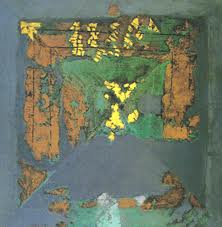 |
| Lukisan abstrak karya Achmad Sadali |
 |
| Lukisan kaligrafi karya A.D. Pirous |
The Islamic theme in Indonesian modern painting, however, is not confined to the use of calligraphic style. Spiritual concepts or associations related to Islamic teaching, and their interpretations, do find their way into Indonesian paintings such as those made by Amang Rachman from Surabaya. To sum up, Islam does fascinate and inspire Indonesian creative artist, in all forms of art in general, and visual arts in particular. ( POSTED BY SLAMET PRIYADI IN LIDO – BOGOR – WEST JAVA ).
"SENI MODERN ISLAMI" ( Terjemahan bebas by Slamet Priyadi )
Minggu, 4 Desember, 2011 - Denmas Priyadi Blog : Ahmad Sadali dan A.D. Pirous adalah dua seniman modern Indonesia lulusan Fakultas Seni Indonesia di Bandung, yang memulai karirnya dengan karya-karya seni lukis modern dengan kaligrafi Islam sebagai tema dan ide dasarnya. Adapun ide-ide dasar dan konsep karyanya digali dari seni tradisional Indonesia setelah mereka kembali dari studi di luar negeri di negara barat. Ini adalah semacam kesadaran baru, atau kebangkitan dalam pikiran mereka, bahwa banyak sekali tradisi yang hidup dalam seni tradisi Indonesia menawarkan materi yang cukup menantang untuk dieksplorasi sebagai pekerjaan mereka dalam menggunakan pendekatan seni kontemporer. Dalam hal estetika ingetuity, ketekunan eksploratif tehnical (untuk warna, bentuk, dan tekstur), dan refinerment dalam perasaan, mereka unggul, dan dengan demikian mereka diterima sebagai seniman di antara eksponen terkemuka pelukis Indonesia modern. Pelukis lainnya yang sangat produktif dalam membuat lukisan dengan tema kaligrafi yaitu Amry Yahya dari Akademi Seni di Yogyakarta. Kekhususan dari karya-karyanya sebagian besar menggunakan tehnik batik dalam karya.
 |
| Lukisan batik karya Amry Yahya |
 |
| Amry Yahya |
Tema-tema Islam dalam lukisan Indonesia modern, bagaimanapun, tidak terbatas pada penggunaan gaya kaligrafi. Konsep spiritual atau penafsiran yang berkaitan dengan ajaran Islam, dan interpretasi mereka, tidak menemukan jalan mereka ke dalam lukisan Indonesia seperti yang dibuat oleh Amang Rachman dari Surabaya. Singkatnya, Islam telah mempesona dan menginspirasi seniman kreatif Indonesia, dalam segala bentuk seni pada umumnya, dan seni visual pada khususnya. (POSTED BY SLAMET PRIYADI DI LIDO - BOGOR - JAWA BARAT - INDONESIA).
Langganan:
Postingan (Atom)